
Gemini 4 Carbon, Hydrogen, Decisions API, self-hosted agent sandboxes and more
Last week we shipped 7 launches across models, agent infrastructure, benchmarks, and science: two Gemini 4 models, our first Decision Model & API, self-hosted agent sandboxes, a new visual knowledge benchmark, and new robotics and genomics models.
1. Gemini 4 Carbon
Gemini 4 Carbon, available as gemini-4-carbon, is our strongest reasoning model for repository-scale engineering, formal proofs, and cybersecurity defense.
- Shared 1M-token pool across input, thinking, and output, with long decode chaining 64K hops via background execution.
- Tunable low, medium, and high thinking levels;
temperature,top_p, andtop_kare ignored. - Automatic implicit caching from 4,096 tokens at a 95% discount, retiring
cachedContents. - Introductory pricing at $2.00 input and $10.00 output per 1M tokens through November 30, then $4.00 and $20.00 starting December 1; see the model card and Carbon developer guide.
import { GoogleGenAI } from "@google/genai";

const client = new GoogleGenAI({});

const interaction = await client.interactions.create({
  model: "gemini-4-carbon",
  input: "Find lock-ordering deadlocks in a two-phase commit coordinator and sketch a lock-free alternative.",
  generation_config: {
    thinking_level: "medium",
  },
});

console.log(interaction.output_text);
2. Gemini 4 Hydrogen
Gemini 4 Hydrogen, available as gemini-4-hydrogen, is our recommended upgrade from Gemini 3.8 Flash for everyday coding and fast agentic workflows.
- Priced at a flat $1.50 input and $7.50 output per 1M tokens across the 1M-token window; see the model card and rate limits.
- Flags missing context when data is absent, batches parallel read and search tool calls, and inspects individual frames during agentic video understanding.
- Defaults to the
highthinking level, addsxhighfor multi-step coding problems, and rejects the legacyminimalsetting. - Powers our default Antigravity agent in Gemini Managed Agents.
import { GoogleGenAI } from "@google/genai";

const client = new GoogleGenAI({});

const interaction = await client.interactions.create({
  model: "gemini-4-hydrogen",
  input: "Write a TypeScript token-bucket rate limiter that avoids floating-point burst-boundary drift.",
  generation_config: {
    thinking_level: "xhigh",
  },
});

console.log(interaction.output_text);
3. Choosing your model
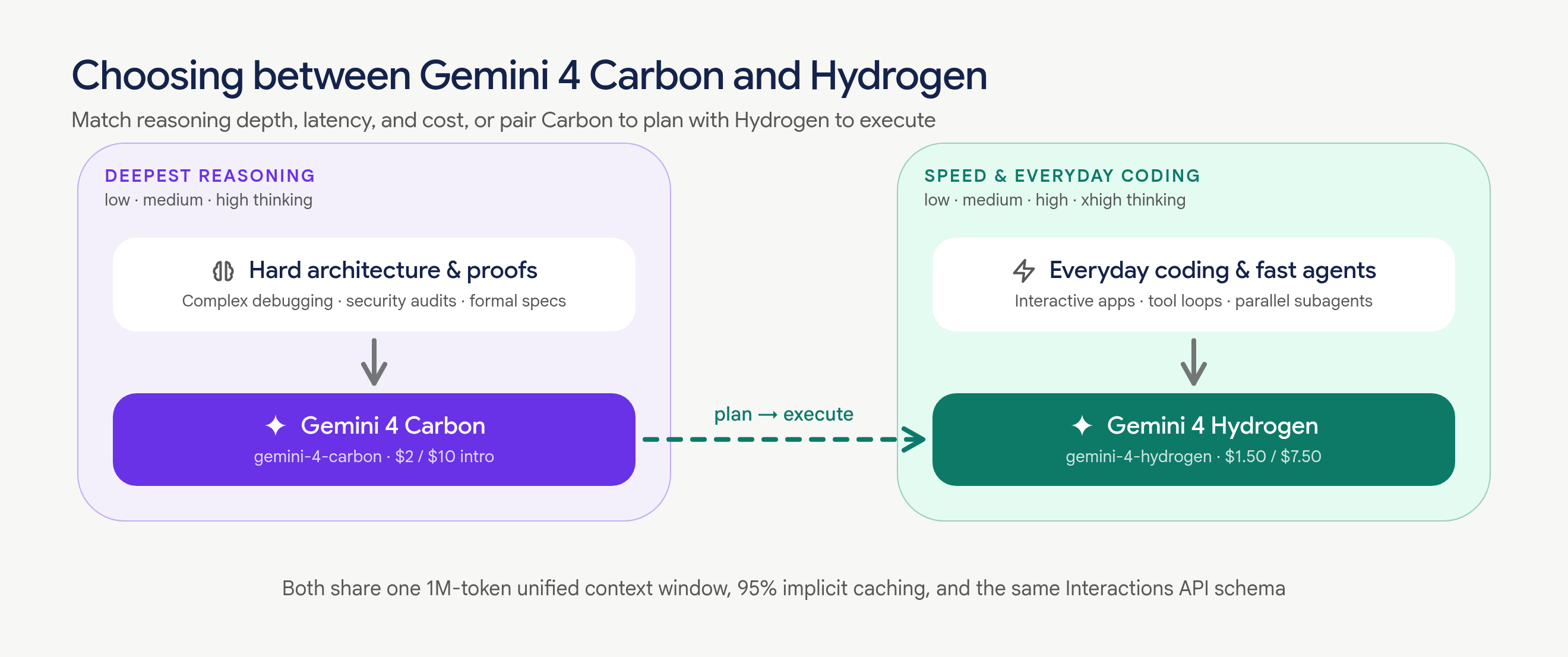
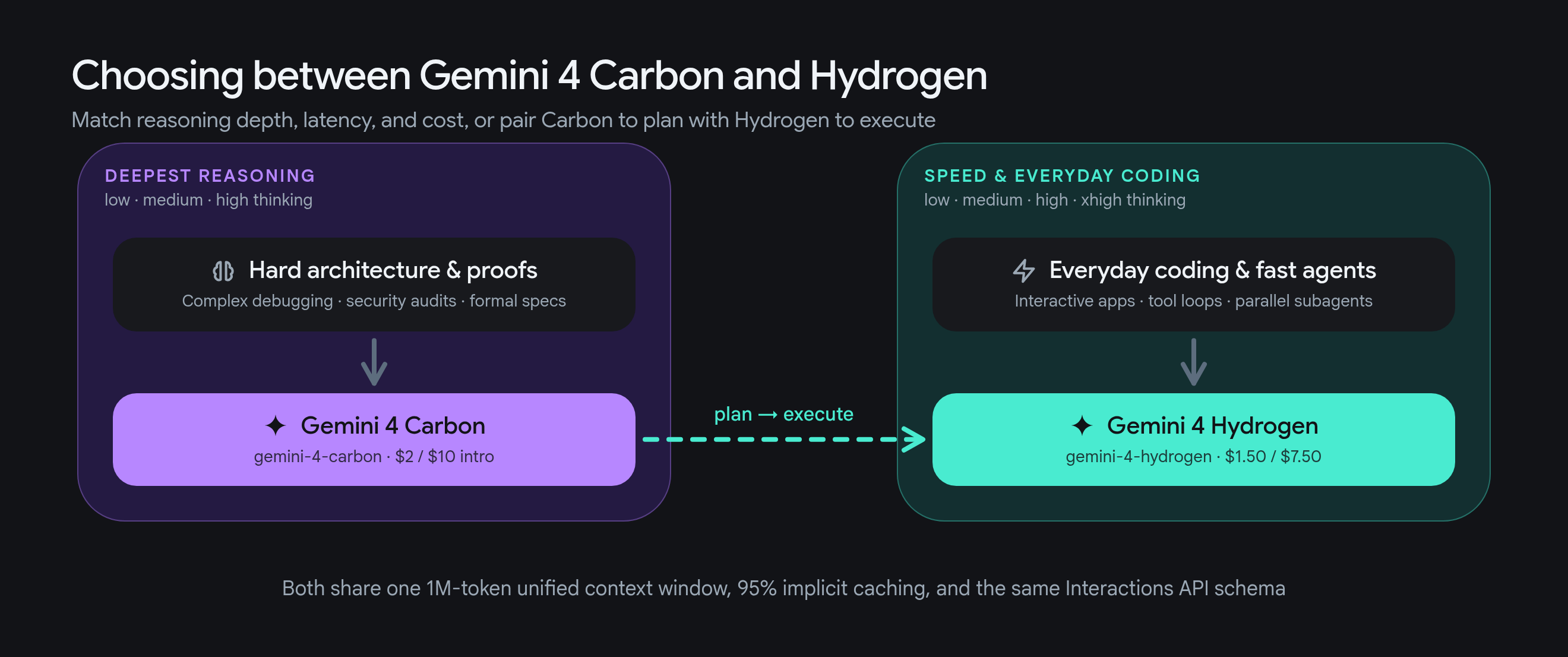
Hydrogen and Carbon share the same 1M unified context window, long decode architecture, and Interactions API schema. Pick the model that matches your reasoning depth, latency, and cost target:
- Gemini 4 Hydrogen: everyday coding, interactive apps, tool-using agents, and parallel subagents.
- Gemini 4 Carbon: hard architecture design, debugging, scientific proofs, and security audits.
You can also pair Carbon and Hydrogen. Use Carbon to plan and orchestrate and Hydrogen to execute.
4. Gemini Decisions API
The Gemini Decisions API, powered by Gemini Decision 1, evaluates text, images, video, PDFs, or audio across up to 256K tokens against up to 1,000 isolated questions with 0 output tokens billed.
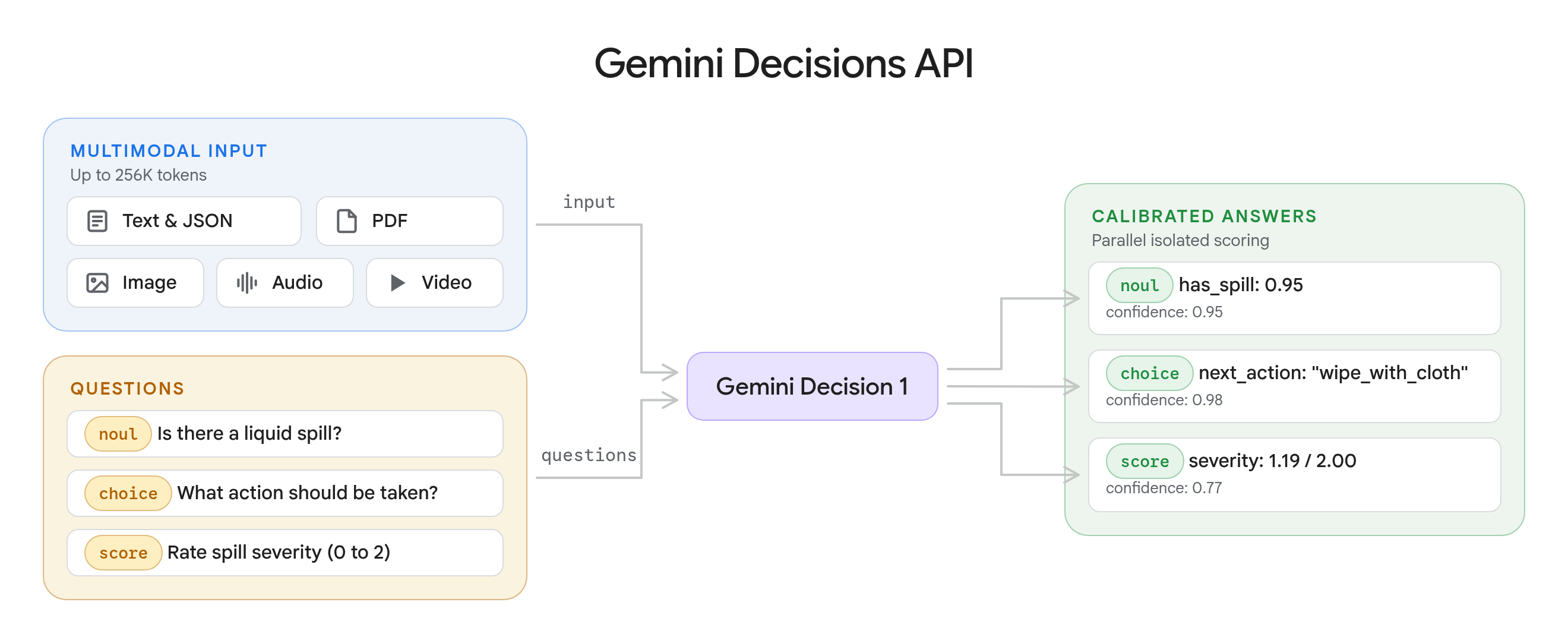
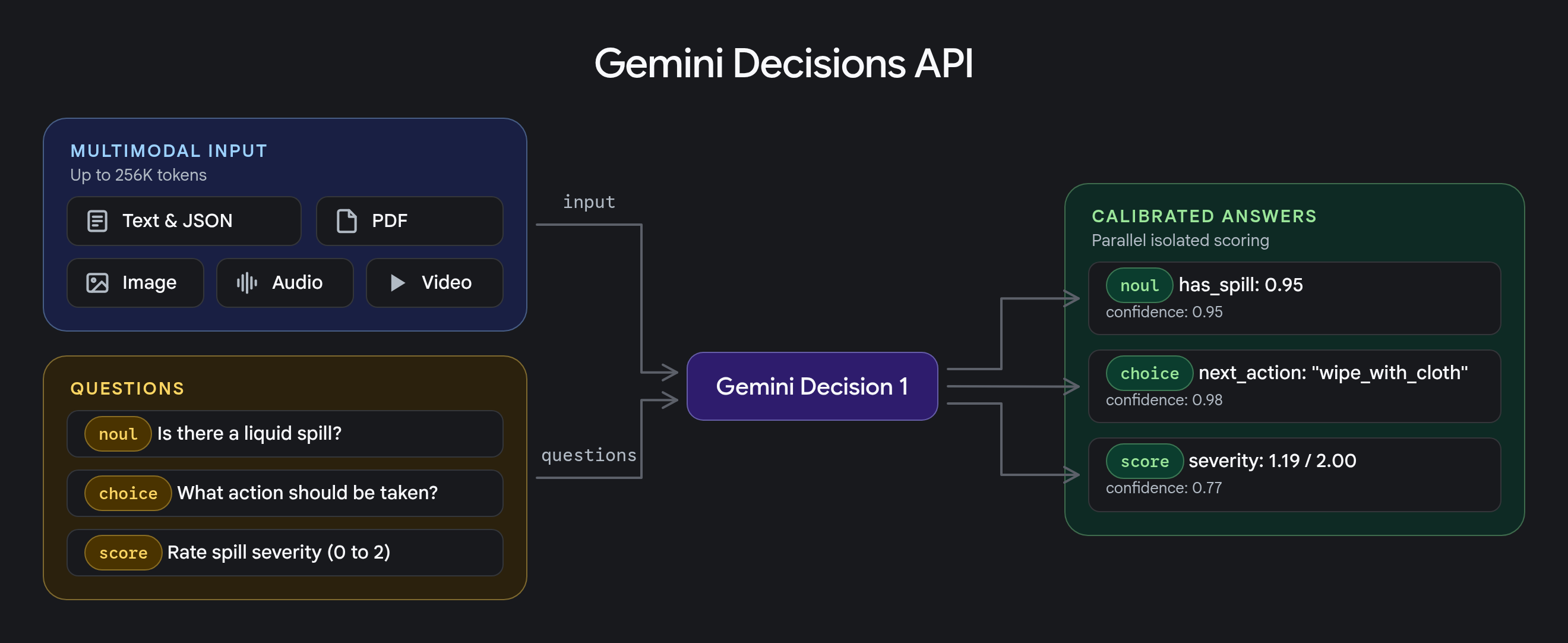
Three question types return calibrated probabilities and a confidence score: noul for binary yes/no checks, choice across 2 to 255 discrete keys, and score for ordered rubrics. Pass media via base64, HTTPS URLs, or the Files API, and test rubrics in the Gemini Decisions Playground. Here's a runnable check over our sample WAV file:
import { GoogleGenAI } from "@google/genai";

const ai = new GoogleGenAI({ apiVersion: "v1beta" });

const result = await ai.decisions.create({
  model: "gemini-decision-1",
  input: [
    {
      type: "audio",
      uri: "https://storage.googleapis.com/generativeai-downloads/audio/rehearsing.wav",
      mime_type: "audio/wav",
    },
  ],
  questions: {
    mentions_launch: {
      type: "noul",
      instructions: "Is the speaker talking about a product campaign launch?",
    },
    delivery: {
      type: "score",
      instructions: "How fluent and prepared does the speaker sound?",
      criteria: [
        "Hesitant, searching for notes, or self-correcting.",
        "Mostly steady with minor pauses.",
        "Polished, fluent, and confident throughout.",
      ],
    },
  },
});

const launch = result.answers?.mentions_launch;
const delivery = result.answers?.delivery;
if (launch?.type === "noul" && delivery?.type === "score") {
  console.log({ pLaunch: launch.noul, deliveryScore: delivery.score });
}
5. Bring your own sandbox for managed agents
Gemini Managed Agents now supports self-hosted environments. We run model inference and the agent loop on Google infrastructure while bash commands and file edits execute inside your compute.
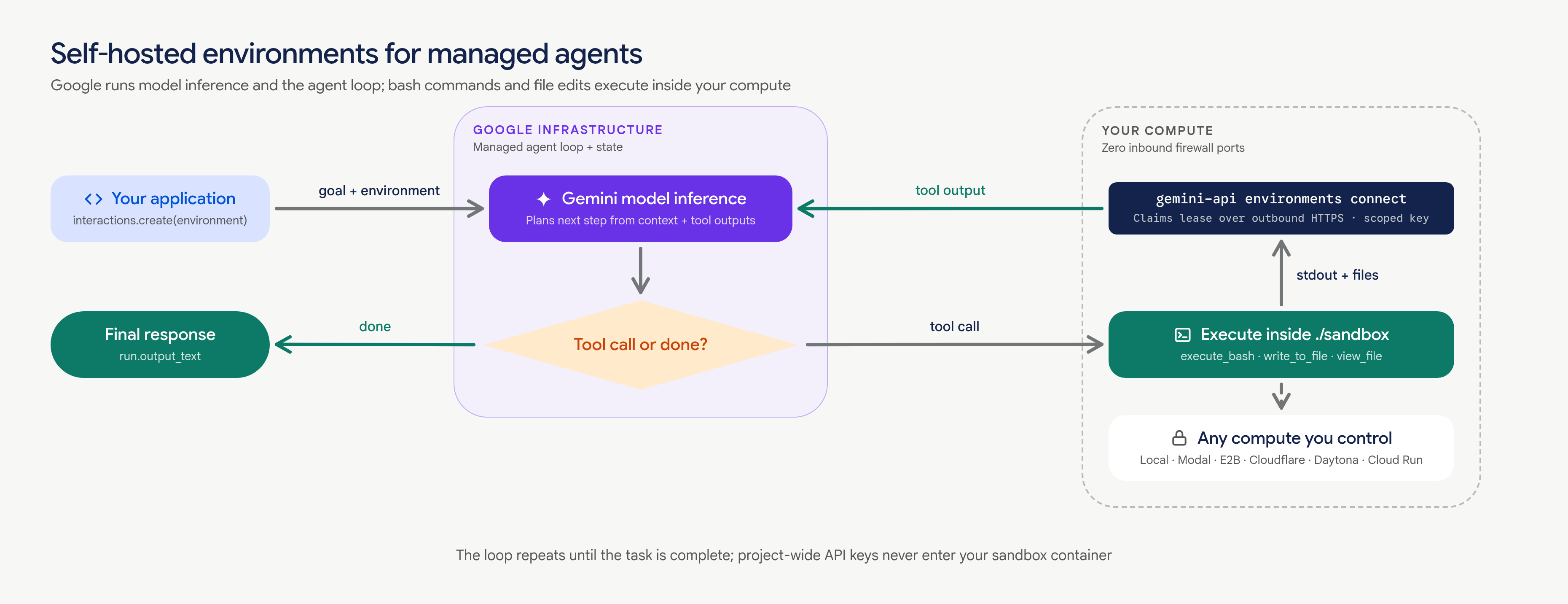
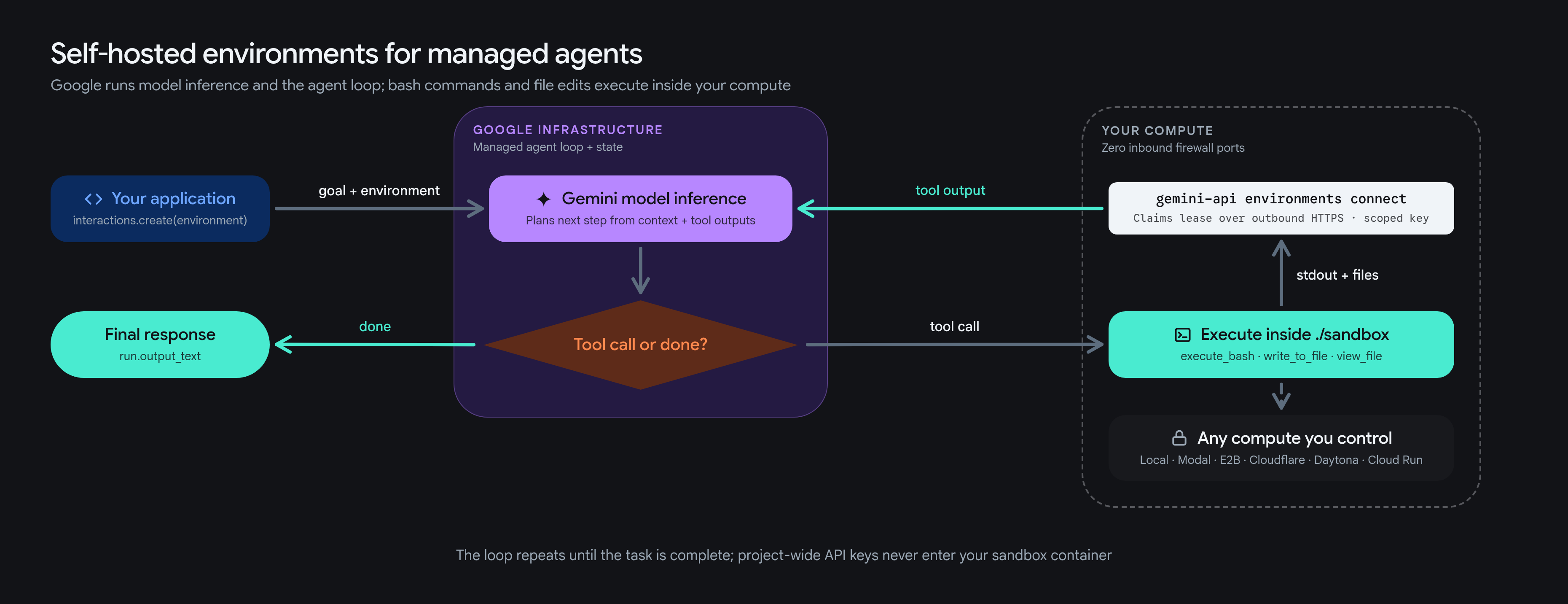
Your worker connects over outbound HTTPS with a scoped key and zero inbound firewall ports. In production, you can deploy across Modal, E2B, Cloudflare, Daytona, Fly.io, Vercel, or Cloud Run using our self-hosted provider manifests.
To test it end to end on your own machine, install our open-source gemini-api CLI from the CLI guide and run this single script. It creates a self-hosted environment via REST, spawns a local worker confined to ./sandbox, runs the managed agent locally, and cleans up the environment when finished. Local mode executes bash directly on your host unless you run inside a container or pass --disable-bash:
import { spawn } from "node:child_process";
import { mkdirSync } from "node:fs";
import { GoogleGenAI } from "@google/genai";

const client = new GoogleGenAI({ httpOptions: { apiVersion: "v1beta" } });
mkdirSync("./sandbox", { recursive: true });

const res = await fetch("https://generativelanguage.googleapis.com/v1beta/environments", {
  method: "POST",
  headers: { "x-goog-api-key": process.env.GEMINI_API_KEY!, "Content-Type": "application/json" },
  body: JSON.stringify({ mode: "self_hosted" }),
});
const { id, environment_key } = (await res.json()) as { id: string; environment_key: string };

const worker = spawn("gemini-api", [
  "environments", "connect", "--environment-key", environment_key,
  "--root-dir", "./sandbox", "--workdir", "./sandbox", "--worker-id", "local-sandbox",
], { stdio: ["ignore", "inherit", "inherit"] });

try {
  const run = await client.interactions.create({
    agent: "antigravity-preview-09-2026",
    input: "Write a fib.ts script that prints 8 Fibonacci numbers, run it with bun, and return the output.",
    environment: id,
  }, { timeout: 300000 });
  console.log(run.output_text);
} finally {
  worker.kill();
  await client.environments.delete(id);
}
Running the script prints the local worker logs alongside the agent output:
$ bun run sandbox.ts
2026/11/16 13:40:30 Worker local-sandbox polling (maxConcurrent=4)
2026/11/16 13:40:30 [v1_Chd5d2Y3...] Claimed interaction lease (env=f5621577-89ef-4698-999f-b139b9121d00)
2026/11/16 13:40:31 [v1_Chd5d2Y3...] Executing tool execute_bash
2026/11/16 13:40:35 [v1_Chd5d2Y3...] Executing tool write_to_file
2026/11/16 13:40:38 [v1_Chd5d2Y3...] Executing tool execute_bash
2026/11/16 13:40:54 [v1_Chd5d2Y3...] Completed interaction session
Created fib.ts and ran it with bun fib.ts: 0 1 1 2 3 5 8 13
6. Multimodal Knowledge Agent benchmark
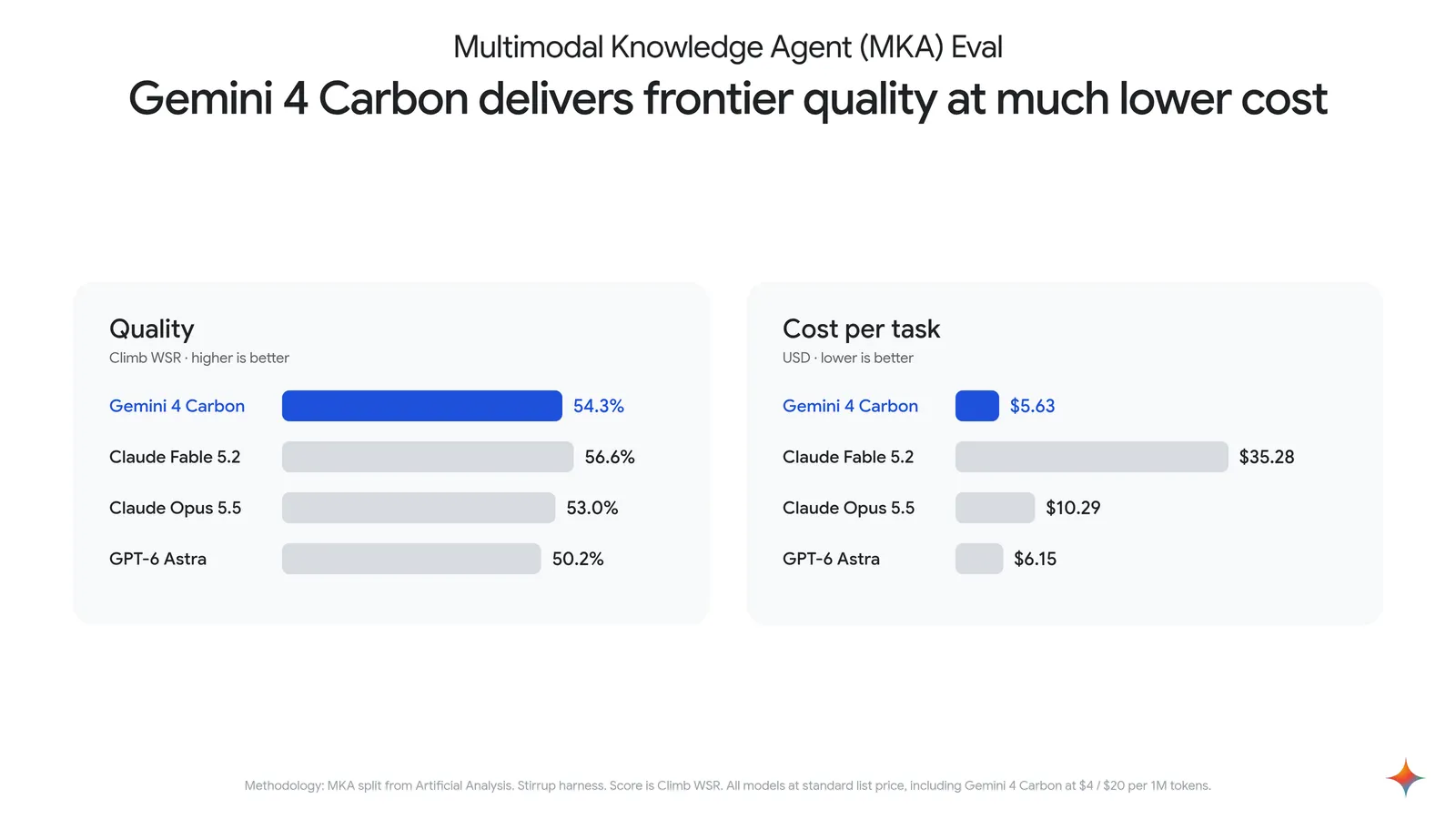
We partnered with Artificial Analysis to release the Multimodal Knowledge Agent benchmark, evaluating 200 multi-step tasks across 10 verticals built around load-bearing visuals: CAD blueprints, RF schematics, GIS maps, gel plates, and charts. We published 10 sample tasks on Hugging Face.
7. Beyond the API: Gemini Robotics 2.5 and AlphaGenome 2
We also shipped two domain models:
- Gemini Robotics 2.5: our whole-body Vision-Language-Action model across arms and humanoids. On live Mercedes-Benz assembly lines, Apptronik's Apollo 2 humanoid sorted and kitted metal brackets at a 96% success rate.
- AlphaGenome 2: our single-cell DNA model trained on 107M+ cell profiles across 68 tissues. Researchers can pass scRNA-seq profiles without retraining via the AlphaGenome API for non-commercial research to predict cell-type-specific variant effects.
Start building with Cloud credits
We added Google Developer Program Cloud credit claiming directly into Google AI Studio. Google AI Pro and Ultra subscribers can now claim and track their monthly Cloud credits in AI Studio alongside API billing to offset Gemini 4, Gemini Decisions API, and agent usage.
Start building today or leave feedback below!